
Line Reactor vs Load Reactor for VFDs: Complete Sizing & Selection Guide
Mar 18,2026 | nretec
In my years working on the production floor at NRE, one question comes up again and again from our B2B customers: "My VFD keeps tripping — do I need a line reactor, a load reactor, or both?"
It's a great question, and the confusion is understandable. Both devices look nearly identical — they're both inductors wound on a steel core. But they do completely different jobs and are installed in different locations in your drive system. Getting this wrong means either an unprotected VFD that fails prematurely, or an unprotected motor suffering insulation breakdown from PWM voltage spikes.
This guide cuts through the confusion with a plain-language breakdown, a direct comparison table, and our impedance selection guide — the information most competitors leave out.
What Is a VFD Line Reactor?
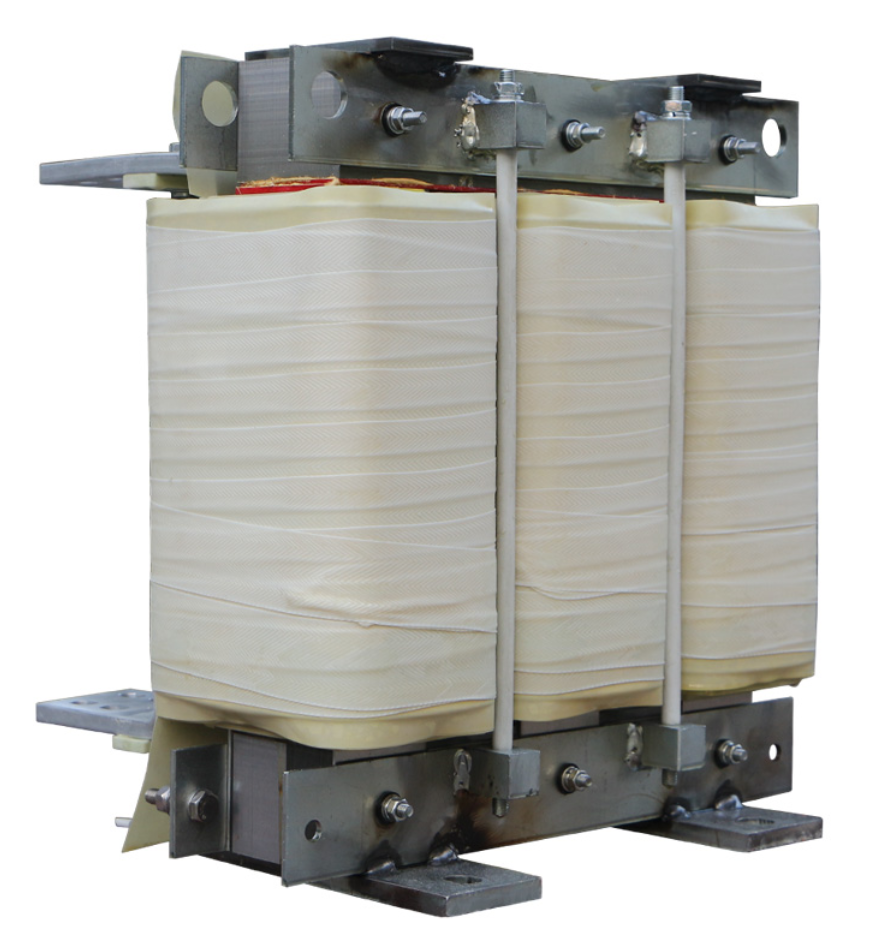
A VFD line reactor — also called an AC line reactor, input reactor, or simply a "choke" — is a three-phase inductor installed on the input (line) side of a variable frequency drive (VFD). It sits between the utility power supply and the VFD's input terminals.
Structurally, a line reactor consists of a laminated electrical-grade steel core with copper-wound coils on each of the three phases (for 3-phase systems). When current flows through the coils, a magnetic field builds up that resists rapid changes in current — this is the core mechanism of reactor protection.
How a Line Reactor Protects Your VFD
- Reduces harmonic distortion: VFDs draw non-sinusoidal current from the grid, causing total harmonic distortion (THD). A line reactor can reduce THD from a typical 85% (bare VFD) down to 30–35%, making your system IEEE 519 compliant.
- Dampens voltage spikes: Grid switching events generate transient voltage spikes up to hundreds of amps. A 3% line reactor limits these spikes to safe levels. In one study, an unprotected 25HP drive saw current spikes of 805A from grid transients; a 3% reactor reduced this to 55A.
- Prevents nuisance tripping: Line reactors smooth the incoming current waveform, reducing overvoltage trips that interrupt production.
- Extends VFD component life: Diodes, transistors, and capacitors inside the VFD all last longer when protected from current surges.
- Improves power factor: By reducing peak charging currents and harmonic currents, line reactors improve the displacement power factor of your system.
What Is a Load Reactor?
A load reactor — also called an output reactor or motor choke — is installed on the output (load) side of the VFD, between the VFD and the motor. It has the same basic structure as a line reactor but is tasked with a completely different problem: managing the VFD's PWM switching output.
Modern VFDs use Pulse Width Modulation (PWM) to synthesize an AC waveform. The rapid switching of IGBTs (transistors) creates a square-wave voltage output with very fast rise times (high dV/dt). This is problematic for motors in two ways:
- Motor insulation damage: Repeated high-voltage spikes stress motor winding insulation, causing premature breakdown — especially in older motors not rated for inverter duty.
- Bearing currents: High-frequency PWM pulses can induce currents that flow through the motor shaft and bearings, causing pitting and accelerated wear.
- Reflected waves: In long cable runs (>100 feet), PWM pulses reflect off the motor terminals and can double the voltage spike (up to 2× DC bus voltage), further stressing insulation.
A load reactor smooths the sharp edges of these PWM pulses —reducing dV/dt and damping reflected waves — so the motor sees a cleaner waveform.
Line Reactor vs Load Reactor: Side-by-Side Comparison
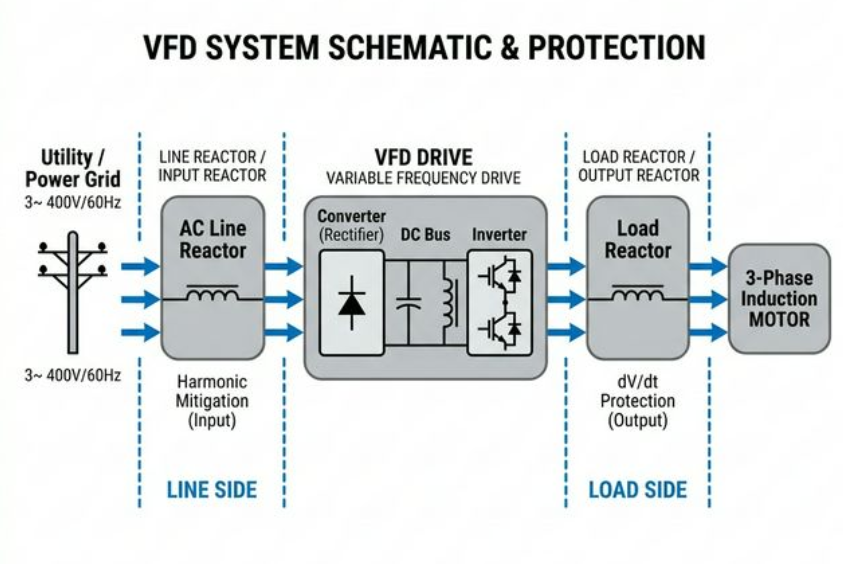
| Parameter | Line Reactor (Input Reactor) | Load Reactor (Output Reactor) |
|---|---|---|
| Installation Position | Between grid/transformer and VFD input | Between VFD output and motor |
| Primary Function | Protect VFD from grid transients; reduce harmonic distortion | Protect motor from VFD switching; reduce dV/dt and reflected waves |
| What It Protects | The VFD (and upstream power system) | The motor (and motor cabling) |
| Typical Impedance | 3% (standard) or 5% (IEEE 519 required) | 5% (standard for motor protection) |
| When Recommended | Supply transformer >10× VFD kVA; multiple VFDs on one bus; nuisance tripping; IEEE 519 compliance | Cable length >100 ft (30m); older non-inverter-duty motors; long-lead applications |
| Harmonic Reduction | Reduces THD from ~85% to ~30–35% | Minimal harmonic reduction (load-side focus) |
| dV/dt Protection | Limited (not its primary role) | Yes — key function |
| Power Factor Effect | Improves overall system power factor | Negligible effect on power factor |
| Voltage Drop | ~3% or ~5% voltage reduction to VFD | ~5% voltage reduction to motor |
| Can One Serve Both Roles? | Same device type, but must be sized and rated for its specific position. Always verify manufacturer specs. | |
How to Choose: 3% or 5% Impedance?
This is the specification question we get most often at NRE, and it's something most competitor articles gloss over. Here's our practical decision framework:
| Scenario | Recommended Impedance |
|---|---|
| Standard VFD protection in North America (line-side) | 3% |
| IEEE 519 harmonic compliance required | 5% |
| Installation outside North America (EU, Asia) — stricter harmonic limits | 5% |
| Motor protection on load side (standard) | 5% |
| Multiple motors controlled by single VFD (one shared load reactor) | 5% |
| Significant existing harmonic distortion on supply | 5% |
AC Line Reactor vs DC Link Reactor
There is a third type worth understanding: the DC link reactor (DC choke), installed inside the VFD at the DC bus level. Unlike external AC line reactors:
- DC link reactors (DC chokes) are built into the VFD, not external add-ons
- Both AC line reactors and DC chokes reduce total harmonic distortion (THD), but AC line reactors provide the additional advantage of full power-side protection since they sit upstream of the VFD
- Some VFD manufacturers include a built-in DC choke; in that case, an external 3% AC line reactor still adds value for upstream protection
NRE Reactor Specifications for VFD Applications
At NRE, we manufacture industrial reactors for a wide range of VFD and power quality applications. Our reactors are built at our 82,700 m² facility in Foshan, Guangdong — with over 30 years of experience in magnetic component manufacturing.
All product parameters below are sourced directly from the NRE Reactor product catalog. Do not rely on third-party sources for our specifications.
| Parameter | NRE Reactor Specification |
|---|---|
| Power Range | 5 KVA – 2000 KVA |
| Working Frequency | 50 Hz or 60 Hz |
| Efficiency | ≥ 98% |
| Insulation Class | Class B, Class F, Class H |
| Short Circuit Impedance | ≤ 5% or as required (customizable) |
| Applications | UPS, EPS, VFD (variable frequency drives), solar/wind energy systems, industrial machinery, railway systems |
| Certifications | ISO 9001, ISO 14001, CE, UL, VDE, TUV, CQC, RoHS |
| Customization | Power, voltage, impedance %, insulation class, dimensions — all customizable to OEM specifications |
| Special Variants | Harmonic filter reactor (high-voltage series), welding machine vertical wound reactor, EV charging current-limiting reactor (10–630 KVA), solar inverter double reactor |
We also stock a Three-Phase Iron Core Dry Type High Voltage Series Harmonic Filter Reactor specifically designed for transformer substation and high-harmonic VFD environments. See the full specification in our reactor collection.
When Should You Use Both a Line Reactor AND a Load Reactor?
In our experience working with industrial customers across UPS systems, HVAC plants, and renewable energy installations, the best practice is to use both when:
- Your supply transformer is large relative to the VFD (rule of thumb: transformer kVA > 10× VFD kVA) AND you have long motor cable runs (>100 ft)
- Older motors are involved — non-inverter duty motors need the dV/dt protection of a load reactor even if the VFD is well-protected on the input side
- IEEE 519 compliance is mandatory — a single line reactor may not be sufficient; pair with a harmonic filter for full compliance
- Critical uptime applications (pharmaceutical, semiconductor fab, data center cooling) where any unplanned motor or drive failure has severe consequences
The total cost of adding both reactors is almost always less than the cost of one unplanned failure. In our factory, we treat reactors as the cheapest insurance you can buy for a VFD system.
Quick Selection Workflow: Which Reactor Do You Need?
| Your Situation | Line Reactor? | Load Reactor? |
|---|---|---|
| VFD tripping frequently, supply power is "dirty" | ✅ Yes | Optional |
| Motor overheating despite correct sizing | Optional | ✅ Yes |
| VFD-to-motor cable > 100 feet (30m) | Optional | ✅ Yes |
| IEEE 519 harmonic compliance required | ✅ Yes (5%) | Optional |
| Supply transformer > 10× VFD kVA | ✅ Yes (3%) | Optional |
| Critical application + older non-inverter-duty motor | ✅ Yes | ✅ Yes |
Frequently Asked Questions
Q: What is the difference between a line reactor and a load reactor?
A line reactor is installed before the VFD and protects the drive from grid-side disturbances (harmonics, voltage spikes). A load reactor is installed after the VFD and protects the motor from the VFD's PWM switching transients and dV/dt voltage spikes. Both are inductors, but the protection direction is different.
Q: When do I need a VFD line reactor?
Install a VFD line reactor when: (1) your supply transformer is more than 10× the kVA of the VFD; (2) you experience nuisance tripping; (3) IEEE 519 compliance is required; (4) multiple VFDs share a common power bus. A 3% impedance reactor covers most North American industrial applications.
Q: Should I use 3% or 5% impedance?
Use 3% for standard VFD line-side protection in North America. Use 5% when IEEE 519 compliance is needed, when operating outside North America, or for load-side (motor) protection.
Q: Can a line reactor and load reactor be the same unit?
Physically, yes — they're the same type of electromagnetic device. But they must be individually sized for their position. A line reactor is typically 3% impedance; a load reactor is typically 5%. Some manufacturers rate reactors for both positions; others do not. Always verify before applying.
Q: Does adding a reactor reduce motor voltage?
Yes. A 3% reactor drops approximately 3% of the supply voltage; a 5% reactor drops approximately 5%. Factor this into motor sizing, particularly for applications where the motor is already running near full load.
Related NRE Resources
- 🔗 Browse NRE Reactor Products — Our full reactor collection including harmonic filter reactors, welding machine reactors, and EV charging reactors
- 🔗 Three-Phase Reactor Dimensions Chart — Size and power rating reference table for 3-phase reactors (1–1000 kvar)
- 🔗 Single-Phase Reactor Dimensions Chart — Dimensions and ratings for single-phase reactor applications
- 🔗 Industrial Transformer Procurement Guide — How to specify transformers and reactors for industrial projects
- 🔗 Request a Custom Reactor Quote — Tell us your VFD power rating, voltage, impedance requirement, and we'll size the right reactor for your application
For technical standards compliance references:
- 📄 IEEE 519 Standard — Recommended Practice and Requirements for Harmonic Control in Electric Power Systems
- 📄 IEC 61558 — Safety of Transformers, Reactors, Power Supply Units and Combinations
Need a Custom Reactor for Your VFD System?
NRE manufactures reactors from 5 KVA to 2000 KVA with customizable impedance, insulation class, and dimensions. Our engineering team will help you specify the right reactor for your line-side and load-side requirements.
Get a Free Reactor Quote
Comment