
K-Factor Transformer Guide: Ratings, Selection & Why Non-Linear Loads Demand One
Mar 19,2026 | nretec
-1.jpg?w=800&h=800)
In my years manufacturing transformers at NRE, the call I dread most goes like this: "Our transformer burned out again — it's only 3 years old." Nine times out of ten, the cause is the same: a standard transformer connected to a building full of computers, LED drivers, and variable frequency drives. Nobody warned the buyer that these are non-linear loads, and that they needed a K-factor transformer instead.
This guide explains exactly what that means — why harmonic currents destroy standard transformers, how K ratings work, and how to select the right K-factor for your application. If you've been quoted a K-13 or K-20 transformer and aren't sure why, keep reading.
What Are Non-Linear Loads — and Why Do They Matter?
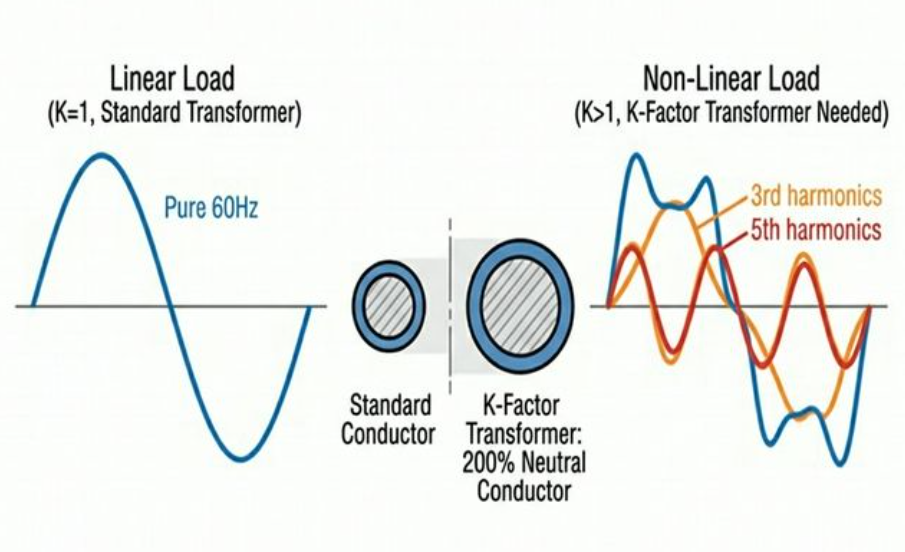
In a standard AC power system, an ideal load draws current in a smooth sine wave, exactly matching the voltage waveform in shape. These are linear loads: motors, incandescent bulbs, resistive heaters. The current and voltage track each other cleanly.
A non-linear load behaves differently. It draws current only in short, sharp pulses — not continuously across the sine wave. The result is a distorted, non-sinusoidal current waveform. When this distorted waveform is broken down mathematically (via Fourier analysis), it reveals a fundamental component at 60 Hz plus additional harmonic components at integer multiples: 120 Hz (2nd), 180 Hz (3rd), 300 Hz (5th), and so on.
Common examples of non-linear loads:
- Personal computers, servers, and data center equipment (switch-mode power supplies)
- LED lighting with electronic drivers
- Variable frequency drives (VFDs) for motor control
- UPS systems and battery chargers
- Medical equipment: MRI machines, CT scanners, monitors
- Arc furnaces, arc welders
- Fluorescent lighting with electronic ballasts
- Solar inverters and EV charging stations
Today, non-linear loads are no longer found only in heavy industrial plants. A modern office floor with 100 computers may have 70–80% non-linear load content. This is why K-factor transformers are now standard specification in data centers, hospitals, and office buildings everywhere.
So what exactly happens inside a standard transformer when it meets these loads — and why does it fail? Let's look at the three physical mechanisms.
How Harmonic Currents Damage a Standard Transformer
There are three primary failure mechanisms in a standard transformer exposed to harmonic-heavy non-linear loads:
1. Winding Eddy Current Losses (Skin Effect)
At 60 Hz, eddy currents within the winding conductor are manageable. But at the 5th harmonic (300 Hz) or 7th harmonic (420 Hz), eddy current losses scale with the square of the harmonic number. The 5th harmonic causes 25× more eddy current loss per unit current than the fundamental. This heat concentrates in the winding conductor, accelerating insulation degradation. NRE's K-rated windings use specially shaped or subdivided conductors to distribute this heat more evenly.
2. Core Hysteresis Losses
A transformer core switches magnetic polarity at the supply frequency. At 60 Hz, this is 60 reversals per second. The 5th harmonic forces 300 reversals per second in that harmonic component — generating proportionally more hysteresis losses (heat from magnetic domain reversals). A standard core is not designed for this, and will run noticeably hotter.
3. Neutral Conductor Overloading (The Hidden Killer)
In a balanced three-phase system, the 60 Hz fundamental currents in the three phase conductors cancel each other in the neutral — resulting in near-zero neutral current. This is why standard transformers use a neutral conductor sized for 100% of phase current.
Triplen harmonics (3rd, 9th, 15th…) do not cancel. They are additive in the neutral. In a system dominated by single-phase computers drawing heavy 3rd harmonic current, the neutral can carry up to 200% of the phase conductor current. A standard neutral conductor at 100% rating will overheat and its insulation will fail — creating a serious fire hazard.
Knowing why a standard transformer fails is only half the picture. The more useful question is: what exactly does a K-factor transformer do differently to survive the same environment?
What Makes a K-Factor Transformer Different from a Standard Unit?
A K-factor (K-rated) transformer incorporates four design upgrades specifically to handle harmonic heating:
| Design Feature | Standard Transformer | K-Factor Transformer |
|---|---|---|
| Neutral Conductor | 100% of phase conductor capacity | 200% of phase conductor capacity |
| Winding Conductors | Standard solid or stranded conductors | Subdivided/foil conductors to reduce skin effect and distribute harmonic heat |
| Electrostatic Shield | Not standard | Included — shields sensitive electronics from switching transients and common-mode noise |
| Core Design | Optimized for 60 Hz only | Sized to handle higher-frequency magnetic reversals from harmonic content without excessive hysteresis loss |
| Temperature Rise Handling | Rated for sinusoidal loads only | Rated for full load at rated K-factor — can operate at nameplate kVA with stated harmonic content |
| UL Rating | UL listed (standard) | UL 1561 K-factor rated (third-party verified) |
With the design differences clear, the next practical question is: which K-rating does your specific application actually need? Here's the fastest way to answer that.
K-Factor Ratings Quick Selection Table
The K-factor number indicates how many times the 60 Hz winding eddy current losses the transformer can safely dissipate. The higher the K-number, the greater the harmonic tolerance. UL formally recognizes K-ratings of K-1, K-4, K-9, K-13, K-20, K-30, K-40, and K-50 per UL 1561 / ANSI/IEEE C57.110.
| K-Rating | Non-Linear Load % | Typical Applications | NRE Available? |
|---|---|---|---|
| K-1 | 0% (linear loads only) | Motors, incandescent lighting, resistive heaters, motor-generators (no solid-state drives) | Standard transformer |
| K-4 | Up to 35% | HID lighting, induction heaters, welding machines, UPS with input filtering, PLC/solid state controls | ✅ Yes |
| K-9 | 35%–50% | Mixed office loads, medium-density computer environments | ✅ Yes |
| K-13 | Up to 75% | Office buildings with dense computing, hospitals (multibranch receptacle circuits), schools, UPS without input filtering | ✅ Yes |
| K-20 | Up to 100% | Data centers, server farms, hospital critical care / OR, SCR variable speed drives, exclusive data processing circuits | ✅ Yes |
| K-30/40/50 | 100% + extreme harmonic spectrum | Very specific industrial equipment with known severe harmonic profile. Rare and very high cost. | ✅ Custom |
How to Determine Which K-Factor You Need
The K-factor is calculated per ANSI/IEEE C57.110 by weighting each harmonic current by the square of its harmonic order. In practice, you don't need to calculate this by hand. Here's the standard process used in the field:
- Measure your load — Use a power quality analyzer to measure THD (Total Harmonic Distortion) and individual harmonic currents (3rd, 5th, 7th, etc.) at the transformer secondary.
- Apply the quick rule — If you can't measure, use the non-linear load percentage guideline from the selection table above.
- Always round up — If your calculated K falls between ratings (e.g., K = 5.9), always specify the next higher standard rating (K-9 in this case). Never round down on safety margins.
- Add application safety margin — For critical facilities (hospitals, data centers), specify one K-level above your calculated value.
K-Factor Transformer vs. Derating a Standard Transformer
A common question we get at NRE: "Can I just derate a standard transformer instead of buying a K-rated unit?"
The honest answer: sometimes yes, but with significant caveats.
| Factor | K-Factor Transformer | Derated Standard Transformer |
|---|---|---|
| Neutral conductor capacity | ✅ 200% — rated for triplen harmonics | ❌ 100% — still undersized for harmonic neutral current |
| Electrostatic shield | ✅ Included — protects electronics from transients | ❌ Not included |
| Harmonic winding losses | ✅ Minimized by conductor design | ❌ Not reduced — still overheats under high harmonics |
| UL certification for harmonics | ✅ UL 1561 K-factor listed | ❌ Not K-factor certified — liability risk |
| Best use case | New installations, high non-linear load density (K > 4) | Emergency/short-term when K-rated unit is unavailable; K-factor load is minimal (K ≤ 4) |
Our factory recommendation: never derate as a permanent solution for K > 4 environments. The neutral conductor risk alone makes it unacceptable in modern data centers, hospitals, or office buildings. A K-rated transformer is the correct permanent solution.
NRE K-Factor Transformer Specifications
NRE manufactures K-factor transformers for non-linear load environments — this is a dedicated product line in our Special Transformer category. All specifications below are drawn directly from our official product catalog. Do not rely on third-party sources for NRE's specifications.
| Parameter | NRE K-Factor Transformer Specification |
|---|---|
| Power Range | 1 KVA – 1000 KVA |
| Application | Non-linear load environments (computers, VFDs, UPS, electronic ballasts, medical equipment, data centers) |
| Working Frequency | 50 Hz or 60 Hz |
| Voltage Class | ≤ 1000 V |
| Insulation Class | Class B, Class F, Class H |
| K-Ratings Available | K-4, K-9, K-13, K-20 (custom K-ratings available on request) |
| Certifications | ISO 9001, ISO 14001, CE, UL, VDE, TUV, CQC, RoHS |
| Cooling Method | Air natural cooling (AN) or air forced cooling (AF) |
| Customization | Power, voltage, K-rating, insulation class, enclosure type — fully customizable to OEM specifications |
| Lead Time | Standard: 7–15 days. Custom: negotiate based on specification complexity |
Frequently Asked Questions
Q: Can I directly replace a failed standard transformer with a K-factor unit — same kVA?
Yes, and it's the right move. A K-factor transformer can replace a failed standard unit on a like-for-like kVA basis. In fact, this is the most common scenario we see at NRE: a customer's 100 kVA standard transformer burned out serving a computer room, and they need a direct drop-in replacement that won't do the same thing again. Because K-rated transformers are designed to handle the same fundamental load plus harmonic heating, you do not need to upsize the kVA when switching to a K-rated unit — the transformer can safely run at its nameplate rating even under harmonic loading. Just confirm the same voltage ratio, frequency, and physical footprint when ordering.
Q: How much longer does a K-factor transformer last compared to a standard unit in a non-linear load environment?
The difference is significant. In a heavily non-linear environment (K > 9), a standard transformer typically operates 30–60°C above its rated temperature class — cutting insulation life by a factor of 8× to 64× based on the Arrhenius aging rule (life halves per 10°C). In practice, this means a standard transformer rated for 20 years may fail in 2–5 years when serving dense computing or data environments. A properly specified K-rated transformer running at its rated K-level will operate within its thermal design limits and achieve its full rated service life. The cost premium of a K-rated unit is almost always recovered within the first replacement cycle that's avoided.
Q: What's the difference between a K-factor transformer and a harmonic mitigating transformer (HMT)?
This is one of the most common points of confusion we encounter. A K-factor transformer is a passive defense — it is built to physically withstand harmonic heat without being damaged. It does not reduce harmonic currents in your distribution system; the harmonics are still present on both the primary and secondary sides. A harmonic mitigating transformer (HMT) actively reduces specific harmonics using phase-shifting winding configurations (typically cancelling the 5th and 7th on the primary side, and triplens via delta winding). HMTs improve system power quality; K-factor transformers only protect themselves. If you need to reduce harmonics flowing into the utility grid (IEEE 519 compliance) or protect downstream equipment, an HMT or a passive harmonic filter is the correct solution — and a K-factor transformer may still be used downstream of it for individual loads.
Related NRE Resources
- 🔗 NRE Special Transformer Collection — Includes K-factor transformers, three-winding transformers, magnetic integrated transformers, and more (1 KVA – 1000 KVA)
- 🔗 Types of Power Transformers Explained — Understanding the full range from standard distribution to K-rated and phase-shifting transformers
- 🔗 Dry Type vs Oil-Immersed Transformers — Why K-factor transformers are almost always dry-type, and how to choose
- 🔗 Industrial Transformer Procurement Guide — How to specify K-factor transformers and other industrial transformers for procurement
- 🔗 Request a Custom K-Factor Transformer Quote — Tell us your load profile, K-rating requirement, and kVA, and we'll design the right unit
For industry standards and technical references:
- 📄 ANSI/IEEE C57.110 — Recommended Practice for Establishing Liquid-Immersed and Dry-Type Power and Distribution Transformer Capability When Supplying Nonsinusoidal Load Currents
- 📄 UL 1561 — Standard for Dry-Type General Purpose and Power Transformers (K-factor rating framework)
Need a Custom K-Factor Transformer?
NRE manufactures K-factor transformers from 1 KVA to 1000 KVA with selectable K-ratings (K-4, K-9, K-13, K-20, custom). We'll help you determine the correct K-rating for your load profile and design a custom transformer that meets your harmonic environment.
Get a Free K-Factor Transformer QuoteComment